Recently I wrote a paper for my ENWR class that involved much research about the proposal for the construction of a crude oil pipeline through the Midwest of the United States by the TransCanada oil company titled Keystone XL. Research on the various pros and cons of this project brought to my attention the opportunity for creative destruction that crude oil brings to the table in the United States. I am now of the opinion that instead of perhaps supporting the perpetuation of the US's dependency on foreign oil through the potential approval of this pipeline, more resources should be invested in the development and availability of renewable energy to the masses. The creative destruction/phasing out of oil, and in its place the diffusion of sustainable energy would admittedly be a very precarious and difficult situation due to the prevalence of oil in our everyday lives, however it would provide a great opportunity for economic growth. In the debate over Keystone XL and developments in clean energy some embrace this opportunity for creative destruction while others are fearful of it and cling to the oil industry that they know and somehow love. The article from Pew below gives many insightful statistics about who does or does not not support Keystone XL and the continuation of the US' involvement with foreign oil as our primary source of energy.
Pew article:
http://www.people-press.org/2013/09/26/continued-support-for-keystone-xl-pipeline/
http://www.youtube.com/watch?v=680ZSxYJcUQ
Above is a link to a Youtube video that is demonstrative of a particular groups' stigma against Prop 39, a proposition proposed in 2012 in California that would encourage job growth in clean energy. The newscaster representing this opinion seems to be more concerned about potential job loss because of this proposition than the job creation it could foster.
Wednesday, October 9, 2013

Tuesday, October 8, 2013
Violence Continues in Egypt
Over the past week, the violence in Egypt has continued to escalate as dozens more of protested were killed. The United States is expressing concern over these events as the bloodshed has been extensive in Egypt. The protests began after the democratic, inclusive government was overthrown and changed into a military backed regime with exclusive tendencies. The democratically elected leader, Morsi, had been a Muslim and the first leader in Egypt considered to have been truly chosen by the people, as previous elections were more than likely rigged. The new extractive political institution has began to persecute Muslims living within the country, claiming they are trying to stop terrorism. They outlawed the Brotherhood last week, and seized all of their assets as a way of enforcing this policy. The protestors are taking extreme measures to rebel against the religious persecution, most recently shooting guards and setting off car bombs. Although violence is never the right answer, these protestors are trying to push back a government that has become an extractive, unfair institution compared to the inclusive political environment that they thought they were finally achieving during the elections.

The United States does not condone the actions of the Egyptian Government, saying they have "a responsibility to protect all Egyptians and create an atmosphere in which all Egyptians can exercise their universal rights, including free assembly, expression and press." USA TODAY However, the United States government has refused to offically call the act of the military overtaking the government a coup, as that would force them to stop funding to the country. Although the U.S. does not agree with the extractive institution's actions, they do not wish to take action due to the backlash that would most certainly ensue.

The United States does not condone the actions of the Egyptian Government, saying they have "a responsibility to protect all Egyptians and create an atmosphere in which all Egyptians can exercise their universal rights, including free assembly, expression and press." USA TODAY However, the United States government has refused to offically call the act of the military overtaking the government a coup, as that would force them to stop funding to the country. Although the U.S. does not agree with the extractive institution's actions, they do not wish to take action due to the backlash that would most certainly ensue.
Sunday, October 6, 2013
Equatorial Guinea: Extractive Disaster

Francisco Macias Nguema exacted an extractive reign of terror over Equatorial Guinea. Economically F.M. Nguema was a disaster, a true enemy of creative destruction: "[Nguema] was distinctly uneasy around educated people. Before long, he had killed everyone who wore spectacles, a sure sign, in his peculiar opinion, of superior educational accomplishment, and it was dangerous for any Guinean to own so much as a page of printed matter." Acemoglu and Robinson explain the natural tendency of extractive institutions to stifle creative destruction is a major reason growth under extractive institutions is not only rare, but impossible to sustain. As a nation rich in resources, that owes 90% of its GNP to foreign aid, Equatorial Guinea certainly exemplifies this claim.
Additionally, he was infamous for reintroducing forced labor and executing thousands, among much else, it was no surprise his reign ended with a coup. Acemoglu and Robinson would argue that it's also unsurprising Francisco Macias Nguema's successor (his nephew Teodoro Obiang Nguema Mbasogo) yet another leader supporting very similar, very extractive, political and economic institutions.
Robots Invade the Work Place
Economic growth is a product of creative destruction - with each new invention and innovation, old technologies become useless. In this 60 Minutes segment on the impact of robots on the United States economy, Steve Kroft points out the destabilizing effects of this growth mentioned by Acemoglu and Robinson. Kroft interviews MIT economists Andrew McAfee and Erik Brynjolfsson, who believe the current rate of destruction is greater than the pace of creation when it comes to jobs, contributing to the United State's high unemployment rate.
As more advanced robots are developed they are able to do increasingly complicated tasks so that workers doing routine, relatively structured jobs are now easily replaced. Nonetheless, the astonishing scale and pace of creation has led to a massive technology industry and increasing wealth and productivity for the United States. In a nation with extractive institutions this growth could never have occurred.
As Kroft says, "economic evolution has been happening for centuries and society has always adapted to change creating more jobs in the process". This temporary destabilization and imbalance is part of a transformative process necessary for ultimate prosperity.
As more advanced robots are developed they are able to do increasingly complicated tasks so that workers doing routine, relatively structured jobs are now easily replaced. Nonetheless, the astonishing scale and pace of creation has led to a massive technology industry and increasing wealth and productivity for the United States. In a nation with extractive institutions this growth could never have occurred.
As Kroft says, "economic evolution has been happening for centuries and society has always adapted to change creating more jobs in the process". This temporary destabilization and imbalance is part of a transformative process necessary for ultimate prosperity.
Time To Go, New York Times
The same realm of institutions that heavily contributed to the spread of revolution-oriented propaganda at the beginning of the United States of America's existence as a nation may soon be flipping to their final pages. According to a 2006 article by The Economist, antiquated physical newspapers are being replaced and out-competed by the ever expanding world of online news and information sharing. Is this necessarily a bad thing, though?

In another example of creative-destruction, an icon of an era is being slowly replaced by a new form of ingenuity better suited to meet the market's needs. The newspapers themselves understand the changing tides of the computer-fixated world. Those companies that have the best chance at survival have reduced operational costs, including the number of employees, and have shifted their initiatives into the sphere of internet contributors and bloggers. For any traditionalists out there enraged at seeing their favorite newspapers disappearing, like the New York Times, welcome to the new age of media: www.nytimes.com/.

In another example of creative-destruction, an icon of an era is being slowly replaced by a new form of ingenuity better suited to meet the market's needs. The newspapers themselves understand the changing tides of the computer-fixated world. Those companies that have the best chance at survival have reduced operational costs, including the number of employees, and have shifted their initiatives into the sphere of internet contributors and bloggers. For any traditionalists out there enraged at seeing their favorite newspapers disappearing, like the New York Times, welcome to the new age of media: www.nytimes.com/.
Reconciliation After Extractive Institutions in Cuba
The current situation in Cuba reflects fear of the extractive situations that have been in place for a very significant period of time. Hostility in Cuba appears to be deteriotating, and the parties involved have made some headway towards reconciling their dark past, as evident in a recent conference in Miami.
This conference featured speakers from Cuba and speakers who were citizens of the former German Democratic Republic, a state that faced a very similar situation. There was an emphasis on political and economical changes that would lead to amending the situation and acquiring peace between the government and the citizens. In the comparison between these two countries, the article summarizes that "...while economic engagement is a good way to ease Havana’s fears of change, the benefits should not go only to the island’s ruling elites." It demonstrates the long-held disdain for the elites, as they were responsible for the suffering and poor conditions imposed upon the population.
This conference featured speakers from Cuba and speakers who were citizens of the former German Democratic Republic, a state that faced a very similar situation. There was an emphasis on political and economical changes that would lead to amending the situation and acquiring peace between the government and the citizens. In the comparison between these two countries, the article summarizes that "...while economic engagement is a good way to ease Havana’s fears of change, the benefits should not go only to the island’s ruling elites." It demonstrates the long-held disdain for the elites, as they were responsible for the suffering and poor conditions imposed upon the population.
Restaurant Elites vs. Creative Des(truck)tion

Just as in Venice where “Each new wave of
enterprising young men… tended to reduce the profits and economic success of
established elites” (A&R 154), food trucks are beginning to challenge the
brick-and-mortar traditional restaurants. In turn, those restaurants, like the
elites of old, are attempting to “close down the system to these new people”
(A&R 155). These two
articles
address the contemporary clash of old and new.
The restaurant owners have legitimate concerns; as
one owner in Vegas points out, food trucks take advantage of the advertisements
that restaurant owners pay good money on to attract people to their locations.
The trucks will often park right out front and “poach” business. Restaurant
owners in large cities are pushing for regulations prohibiting food trucks from
staying in one spot too long or parking within certain distances of a
brick-and-mortar location.
On the flip side, the argument can be made that the
rise of food trucks is modern creative destruction. As food truck entrepreneur
Amy Le points out, “It’s a free market. Let the consumers decide when and where
they want to eat” (Needleman). Allowing their businesses to flourish “would provide an opportunity for small
businesses to continue to grow and to provide benefits to the District, to
other businesses and to residents and workers” (Morris). I wouldn’t go so far to say that blocking the
rising food truck industry will destroy the economy, but food trucks can cater to ever changing
tastes and lifestyles, and in the end yield more positive results than negative.
The Changing of the Elites in Syria
Acemoglu and Robinson state that an important consequence of extractive institutions is the continual battle for the resources appropriated to the elites by the institutions. This creates a cyclical process in which one set of elites is overthrown and replaced by another group who continue the practice of extracting resources from the state. The Syrian Conflict between the Free Syrian Army and the established government of President Bashar Hafez al-Assad can be analyzed with this view to understand some the the FSA's objectives.

On the surface, the main goal of the Free Syrian Army is to overthrow the government of President Bashar Hafez al-Assad. From a western perspective, any opposition to the human rights atrocities being committed in Syria is viable and worthy of support. However, the equal prevalence of human rights violations by the FSA indicates that the rebels may be fighting for reasons that are not necessarily moral or for the good the the Syrian population. This article about the well-to-do of Damascus raises the idea that if the rebels overthrow Assad it is possible they will target other minorities and compete for the last of the resources in Syria. They are not heroes, but simply another subset of society trying to become the elites.
The Soeharto Era in Indonesia

I believe that Indonesia is an example worth mentioning regarding growth under extractive institution and the persistence it has caused in Indonesia's subsequent development. So to cut the long story short, Soeharto, the second president of Indonesia, led the country using extractive institution where the hand of military reached into every level of society to establish political centralization. Though many human rights were abused under this institution, Indonesia experienced a stunning economic progress during which poverty was cut from almost 60% of the population when Soeharto took office in 1968 to 13% in 1997." Furthermore, Indonesia's economic growth was so rapid that she became one of the eight "high-performing Asian economies" in the early 1990s. Unfortunately, growth under extractive institution in Indonesia suffered the same fate as that in Soviet Union because the great income and social disparity between the elite and the impoverished rendered by the nature of the institution caused a brutal mass riot in May 1998 during which Soeharto's throne was thrown off.
After the riot, Indonesia has been trying to move towards a more democratic system. Unfortunately, many leaders elected in the parliament have instead embezzled the nation's money and misused their political power to build their own wealth by cooperating with few elites. Hence, there has been a reluctance in moving towards inclusive political and economic institution in Indonesia.
The World's Newest Country: South Sudan
On July 9, 2011, after 50 years plagued by civil war and the loss of millions of lives, South Sudan achieved independence from their northern counterparts. As the newest nation in the world, South Sudan has been faced with many problems, a major one being the creation of a centralized government. As Acemoglu and Robinson discuss, a centralized government that people can rely on is crucial to economic growth.

There have long been tensions between the various tribes in South Sudan and currently the country's two biggest tribes, the Dinka and the Nuer, dominate the government. This greatly contributes to a lack of trust on the part of the smaller, unrepresented tribes in the central government. This weakness in South Sudan's institutions, may stifle economic growth for the new country. However, if South Sudan can work to strengthen their institutions and allow for a more pluralistic government in which all citizens are represented, there is hope that the new nation can one day flourish.

There have long been tensions between the various tribes in South Sudan and currently the country's two biggest tribes, the Dinka and the Nuer, dominate the government. This greatly contributes to a lack of trust on the part of the smaller, unrepresented tribes in the central government. This weakness in South Sudan's institutions, may stifle economic growth for the new country. However, if South Sudan can work to strengthen their institutions and allow for a more pluralistic government in which all citizens are represented, there is hope that the new nation can one day flourish.
Saturday, October 5, 2013
The Mali Mess
Mali is a West African country with a long and gloried past. In the middle ages, it boasted a major Muslim university, the metropolis of Timbuktu, and the legendary monarch Mansa Musa, famous for amassing so much gold that it became a virtually worthless commodity.
 Today's Mali is not the same. Last year, the regional branch of Al-Qaeda joined with Tuareg separatists to fight the civilian government. Simultaneously, the military launched a coup in the face of what it saw as a weak response from the state. With the help of several thousand French forces, the Malian forces defeated the Islamist/separatist alliance. In the wake of the French intervention, new elections were held, and Ibrahim Boubacar Keita became President. He promised a swift national unification. However, only this week violence has started up again despite the presence of UN Peacekeeping forces. In addition to Al-Qaeda activity, the military is making trouble in the capital. In a minor diplomatic kerfuffle, President Keita had to leave a meeting with France's President Hollande to deal with the issue. As Radio France International reports, "A French presidential statement stressed that Keita 'has made reconciliation his top priority,'" (RFI).
The trouble in Mali stems from a lack of proper centralization, a problem Acemoglu and Robinson append to other groups, like the nation of Somalia and the Congolese Lele (Acemoglu and Robinson 81, 134). This is especially apparent in last year's conflict - with Islamists, Tuaregs, and the military all vying for power, the civilian state folded under the pressure. This type of instability renders sustained economic growth in the region all but impossible, as locals live under the constant threat of attack from any of the disparate forces. Further, the government's resources are primarily directed at restoring order, which prevents it from focusing too heavily on economic development. All the same, if President Keita can make good on his promise to unite the country, then perhaps a centralized Mali could improve its economic standing enough to evoke the riches of Mansa Musa.
The trouble in Mali stems from a lack of proper centralization, a problem Acemoglu and Robinson append to other groups, like the nation of Somalia and the Congolese Lele (Acemoglu and Robinson 81, 134). This is especially apparent in last year's conflict - with Islamists, Tuaregs, and the military all vying for power, the civilian state folded under the pressure. This type of instability renders sustained economic growth in the region all but impossible, as locals live under the constant threat of attack from any of the disparate forces. Further, the government's resources are primarily directed at restoring order, which prevents it from focusing too heavily on economic development. All the same, if President Keita can make good on his promise to unite the country, then perhaps a centralized Mali could improve its economic standing enough to evoke the riches of Mansa Musa.
Friday, October 4, 2013
The Feudal NFL
In "Why Nations Fail", Acemoglu and Robinson discuss feudal systems in Europe dating back to the 14th century. In a feudal system, "Lords allocated land to peasants, in exchange for which peasants had to perform extensive unpaid labor and were subject to many fines and taxes (Why Nations Fail p. 98)." In How the NFL Fleeces Taxpayers, Gregg Easterbrook argues that this very feudal system exists in the relationship between NFL owners and the taxpayers that live in their team's city. Here, the Lords are the owners of the teams while the peasants are the every day citizens living in the team's city. Rich NFL owners, some of which are valued at $1 Billion, use taxpayers to help pay for new expensive stadiums. The owners already profit from ticket sales, concession sales, and stadium parking just to name a few things; so why should taxpayers have to pay to build and renovate stadiums for owners who they are already making rich through their team purchases? Greed among NFL owners drives them to want more and more for their team, and rather than paying for these goods themselves, they rely on the taxpayers. At the end of the day, all the taxpayers receive is entertainment from their team while the owners profit from them in more ways than one.
Wednesday, October 2, 2013
Somalia and Kenya

Similar to the societies of the Lele and Bushong in Congo, Somalia and Kenya are two neighboring African countries that on the surface do not appear to have many differences. However, this article touches on some of the differences and conflicts between the two nations. The author, Andrew Harding, wrote under this picture that "in the after math of the violent shopping centre siege that left dozens of people dead, many in Kenya and neighbouring Somalia are searching for answers about why and how the attack could happen."
This conflict likely arose from the stark differences between these two societies. While Kenya has a decently strong centralized government, similar to the Bushong people, Somalia is a lawless land not unlike the Lele community. Like the Lele people, rather than have a stable political structure promoting peace and securing private property, Somalians are left to fend for themselves. Considering its lack of a functioning government, it is unsurprising that terrorist cells take root there.
Death Tolls Rise in Iraq
In today's world, many countries are trying to have inclusive institutions that give its citizens equal opportunities to vote and be represented. Iraq, after much turmoil with extractive institutions in place, finally formed a new government in recent years that claimed to be a democracy. This new government held elections, and leaders were elected into office. However, according to an article in USA Today, the conflict has far from ceased. Even though the government is technically representative of the masses, there are opposers in the country to the leaders due to their religious association. There are two types of Muslims, the Sunni and the Shiite, who oppose each other and both hold power in the government under a Shiite president.

The opposition between these two groups is so great that there have been several terrorist attacks within the country that are being attributed to Sunni groups. Bombs are being deployed at funerals and on the streets. The violence reached a peak on Sunday when two vehicles filled with explosives exploded in front of the Directorate of Security in the country's capital, increasing the death toll to 1000. It has gotten so bad within the country that the government has requested help from the US Government to try and stop the violence. Iraq's government is a perfect example of how going from an exclusive to an inclusive political institution is not just a simple transition. People will always oppose the transition, especially if the leaders they want do not get elected into office. The situation becomes complicated when groups are tied to religion like in the case of the Muslims in power, and when two groups so opposite exist in politics.

The opposition between these two groups is so great that there have been several terrorist attacks within the country that are being attributed to Sunni groups. Bombs are being deployed at funerals and on the streets. The violence reached a peak on Sunday when two vehicles filled with explosives exploded in front of the Directorate of Security in the country's capital, increasing the death toll to 1000. It has gotten so bad within the country that the government has requested help from the US Government to try and stop the violence. Iraq's government is a perfect example of how going from an exclusive to an inclusive political institution is not just a simple transition. People will always oppose the transition, especially if the leaders they want do not get elected into office. The situation becomes complicated when groups are tied to religion like in the case of the Muslims in power, and when two groups so opposite exist in politics.
Sunday, September 29, 2013
Sudanese Riots Caused by Lack of Inclusive Institutions
A lack of inclusive political and economic institutions has led to riots in Sudan; the government is trying to impose unpopular (and therefore ineffective) policies.
In an attempt to improve its economy, the Sudanese government lifted their subsidies on gasoline, and massively increased transportation and manufacturing prices, which increased the cost of many commodities.
Responding to this new policy, the CNN report claims, large numbers of primarily working class citizens flooded the streets in the capital city of Khartoum, as well as various other cities across the country. Government forces scrambled to control the riots, which emerged without any form of organized leadership, implying a general public outcry.

Saturday, September 28, 2013
Creative Destruction in the Music Industry

This is a textbook example of the way innovation invites creative destruction. When people found out about Apple's new music model, where customers buy music online and listen to it on an iPod, many chose it over buying CDs. When iPods and iTunes grew more popular, the music CD industry declined. A physical product takes more energy and money to create than a digital one, and thus also sells for more, so when
the iTunes model made buying music simple and easy, the music business as a whole shrunk.
http://money.cnn.com/2013/04/25/technology/itunes-music-decline/index.html
Friday, September 27, 2013
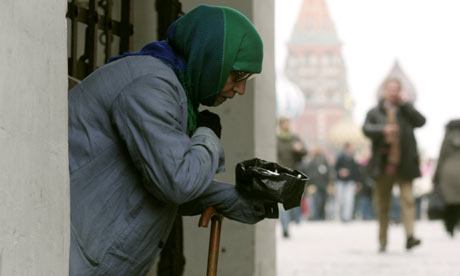
State of Russian Economy Today
Five Important Facts about the Russian Economy

http://static.guim.co.uk/sys-images/Guardian/Pix/pictures/2009/8/31/1251742020483/Beggar-in-passage-to-Mosc-001.jpg
After reading Acemoglu and Robinson's take on the development of the Soviet Union economy during the 20th century, I became curious about the state of the Russian economy today. Their of the persistence of political and economic decisions of the past influencing modern-day institutions seems to hold some water in this case study. The former Soviet Union has yet to successfully and fairly implement strategies that would lead to the development of a market economy, failures that the article above attributes to a lack of judicial independence from corrupt political structures. I think that there are many factors that can influence economic growth in a nation, and it's hard to point to the political decisions of the past as the primal cause for the perpetuation of social, economic and political stability with 100% certainty.
Nonetheless, Alexeev seems to agree with Acemoglu and Robinson in that there is still a prevalent cultural mindset that causes Russians to discourage themselves from taking initiative, problem solving, or taking creative risks.
http://static.guim.co.uk/sys-images/Guardian/Pix/pictures/2009/8/31/1251742020483/Beggar-in-passage-to-Mosc-001.jpg
After reading Acemoglu and Robinson's take on the development of the Soviet Union economy during the 20th century, I became curious about the state of the Russian economy today. Their of the persistence of political and economic decisions of the past influencing modern-day institutions seems to hold some water in this case study. The former Soviet Union has yet to successfully and fairly implement strategies that would lead to the development of a market economy, failures that the article above attributes to a lack of judicial independence from corrupt political structures. I think that there are many factors that can influence economic growth in a nation, and it's hard to point to the political decisions of the past as the primal cause for the perpetuation of social, economic and political stability with 100% certainty.
Nonetheless, Alexeev seems to agree with Acemoglu and Robinson in that there is still a prevalent cultural mindset that causes Russians to discourage themselves from taking initiative, problem solving, or taking creative risks.
Thursday, September 26, 2013
The Looming Shadow of Persistence
Though present
extractive institutions are the main focus of this article, what is more troubling is the mindset of persistence that is foreshadowed.
With this past election, “Few people believe that they
(would) be free and fair” (Coltart), and they were of
course correct. The corrupt and tyrannical political party, the African Nation
Union-Patriotic Front, led by Robert Mugabe, once again was ‘elected’ into
office.
As stated, this was no
surprise, so even though it’s not the best thing ever, it’s not the worst. Its
legacy is what will leave the country and people scarred. The author of the
article is hopeful that change will come, and when it does, “the nation will have to rediscover the rule of law and the
sanctity of persons and property” (Coltart); but people have come to expect that things can’t change, so
there is not initiative to try, especially if the reigning political party will
murder you for it. Even when/if a better institution
rises up, it “will have to find a way for the people of Zimbabwe to heal
the wounds caused by decades of political violence” (Coltart). Because there is currently no room for hope, the
citizens will tumble into a
persistent cycle of fear and oppression for the foreseeable future, possibly
undermining any reconstructive efforts.
Wednesday, September 25, 2013
Treating acne is all about the money
 We have travelled to the moon, developed the field of quantum mechanics, and created glow-in-the-dark animals, yet we are incapable of curing acne. The question arises if this really is the case, and the answer is no. George McCumiskey points out the all too obvious - that acne is a multibillion dollar business. There is an uncountable number of acne companies and products - all fairly ineffective at treating acne - that all thrive on the same old recipe in this huge consumer market. McCumiskey states, that "from this point, there is no need to put more money into improving product effectiveness." And the reason for this is that it would decrease the total revenue of the companies.
The acne industry touches upon the concept of "creative destruction" from Acemoglu and Robinson's book Why Nations Fail. The acne industry continues to be highly profitable through corruption and by avoiding creative destruction. It spends tons of money bribing the FDA, putting "millions of dollars into lobbying the government for ‘ease of passage," so that its new drugs that aren't very effective are approved and quickly put on the shelves for consumers. It puts barely any money into research as developing a cure, which McCumiskey says is possible, would remove the demand for all its acne products. No demand for acne products would remove any profit in the industry. There is no proof, but I would not doubt that the acne companies are even pumping money into the prevention of such a cure.
Tuesday, September 24, 2013
A Critical Juncture That Changed China
December 1978, along with the opening of the Third Plenary Session of the 11th CPC Central Committee in China, the clique of Xiaoping Deng gradually took control of the Chinese government. This was a critical juncture in modern Chinese history, because Deng, unlike his predecessor, was a supporter for economic liberty. Believing that a market economy could help to improve the living standards in China, Deng carried out a series of new policies including reforms in the countryside (let the peasants participate in market economy) and reforms in the costal areas like Shenzhen and Zhuhai (encourage international trades and investments).

Deng's policy helped to create an inclusive economic structure in China, which, although still maintained an exclusive political institution, is able to achieve economic growths thanks to that. In fact, it has the fastest growing economy in the world and is able to double its GDP every ten years.

Deng's policy helped to create an inclusive economic structure in China, which, although still maintained an exclusive political institution, is able to achieve economic growths thanks to that. In fact, it has the fastest growing economy in the world and is able to double its GDP every ten years.
Subscribe to:
Posts (Atom)